Oxford International Curriculum
Our Curriculum
An all-round, child-centred learning journey from Early Years to Primary.
Learning With Purpose
Oxford International Curriculum
The Oxford International Curriculum offers a new approach to teaching and learning, placing joy at the heart of the curriculum by fostering wellbeing, sustainability and developing real world skills for students’ future academic, personal and career success. It is an all-through curriculum that integrates curriculum materials, continuous professional development, assessment and world class resources.
Seven Strands
Oxford International Curriculum for Early Years
Physical Development
Personal, Social and Emotional Development
Literacy
Maths
Understanding the World
Expressive Arts and Design
Curriculum for Early Years
Four Overarching Principles
The Oxford International Curriculum for Early Years focuses on four principles that underpin the Foundation Stage.
The Unique Child
Helps you identify each child’s strengths and areas for development, and build upon these early experiences to develop their knowledge and understanding.
Positive Relationships
Places a strong emphasis on relationships and wellbeing, linking to the wider Oxford International Curriculum for Wellbeing.
Children Learn and Develop in Different Ways
Allows flexibility and supports you to recognise skills and behaviours, providing ideas to help adapt your teaching to meet the needs of every child.
Enabling Environments
Provides a range of suggestions for resources and organisation supporting learning, underpinning lesson and verbal plans.
Learning Outcomes
The Oxford International Curriculum for Early Years offers endto-end teaching and learning support with year-on-year progression of learning outcomes throughout the Foundation Stage.
Learning
Outcomes
Outcomes
Empowered and Independent
Our students are independent, critical thinkers who are adaptable and look to develop strategies for lifelong learners. They are confident leading on projects but also work well in a collaborative environment.
Ambitious and Self-Motivated
Our students are ambitious and want to strive for success in every aspect of their lives. They take initiative, approach every task with an eagerness to learn and take ownership of their own learning with the utmost integrity.
Inventive and Curious
Our students are inventive, resourceful and creative. They question the world around them with a sense of wonder, and aspire to shape a better future for themselves and their community.
Future-Ready
Our students are more prepared to succeed in the world that lies ahead and have the knowledge, skills and
the drive to achieve any objective they may set themselves. They are comfortable being challenged, acquiring
new skills quickly and always seek
new adventures.
Oxford International Curriculum for Primary Years
The Oxford International Curriculum offers coherence, continuity, and consistency to ensure a smooth transition at every stage of the educational journey, from Early Years through Primary and Lower Secondary.
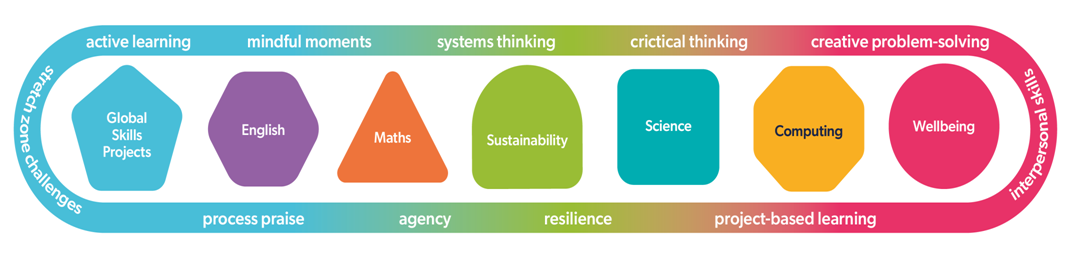
Our Learning Approach
- Enquiry Based Learning
- Learner-Centred Approach with Wellbeing at its Heart
- Project Based Learning
- Place Based Learning
Why Wellbeing matters?
The Oxford International Curriculum helps your child to succeed b recognising that both academic performance and mental wellbeing are highly important for long-term success. The curriculum incorporate wellbeing into teaching and learning across all core subjects.
Positive impacts for living sustainably
The core aim of the Oxford International Curriculum for Sustainability is to help your child with the knowledge, skills and attitudes that will help them make the shift towards a sustainable future.
Living on
Planet Earth
Taking Responsibility
for the Difference We Make
Making Change
Global Perspective
The Importance of Global Skills
The Global Skills Projects are an important part of the Oxford International Curriculum. Through this project work, students engage with real-life problems and develop a variety of vital skills, such as:
Creativity and Critical Thinking
Real-World Skills
Communication and Collaboration
Self-Development Skills
This prepares students for the project-based, analytical, and independent style of learning in the International GCSE and beyond.
Ready to begin your child's learning journey?
Admissions are open for Early Years and Primary programmes.